 BitGo
BitGo Coinbase
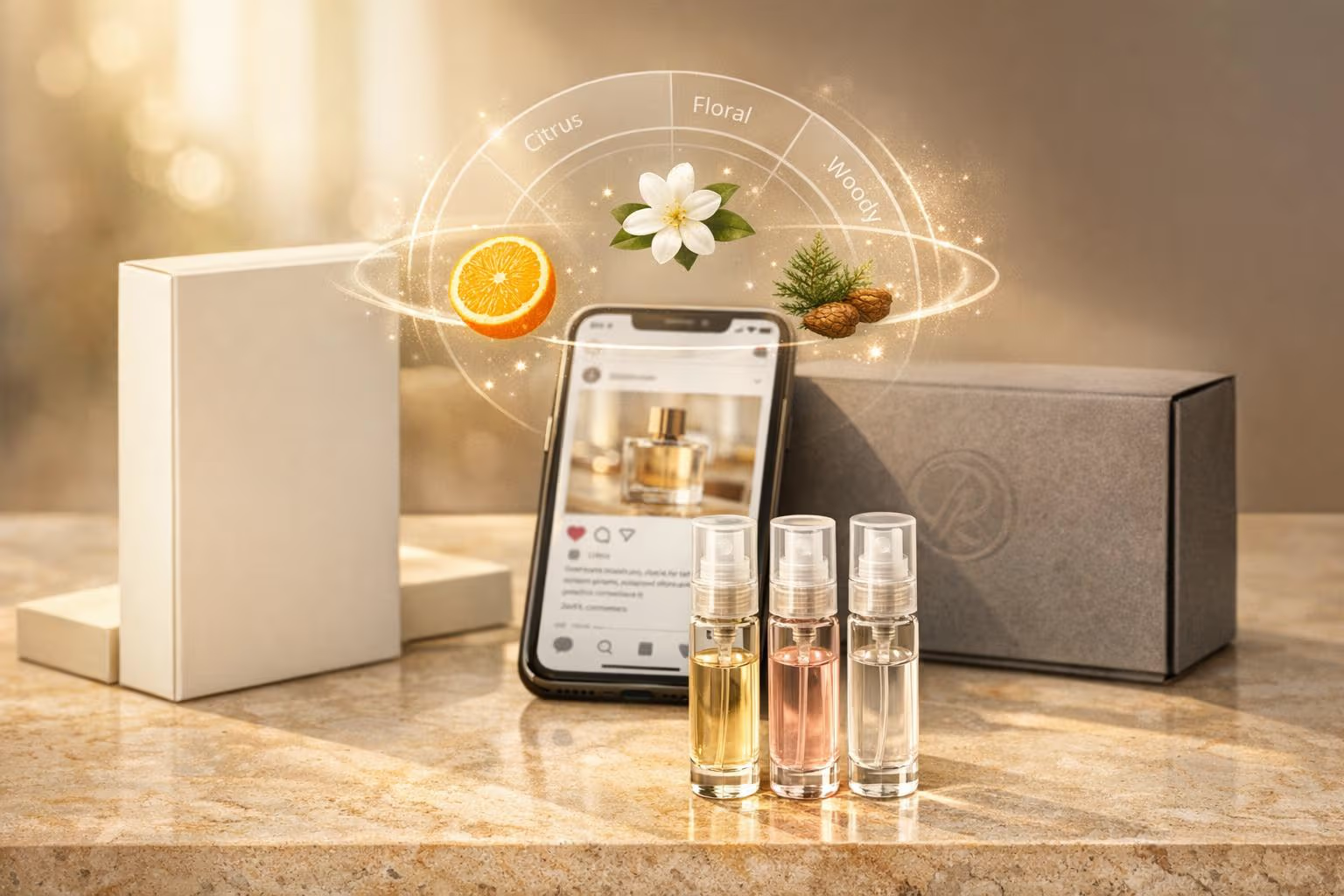
Algorithmic Perfumery: How Artificial Intelligence Is Designing Fragrances That Influence Human Emotions
Exploring Neuroperfumery, Functional Fragrances, and AI-Driven Molecular Design for Stress Reduction, Improved Focus, and Enhanced Emotional Well-Being
For thousands of years, fragrance has been associated with emotion, memory, ritual, and personal identity. Ancient civilizations used aromatic plants in religious ceremonies, medicine, and daily life, long before scientists understood why certain scents could calm the mind, evoke childhood memories, or create a sense of comfort. Today, advances in neuroscience, computational chemistry, and artificial intelligence are transforming this ancient art into a data-driven scientific discipline.
This emerging field—often referred to as algorithmic perfumery or AI-assisted fragrance design—combines machine learning, molecular modeling, sensory science, and psychology to develop perfumes tailored for specific emotional experiences. Rather than relying solely on the intuition of expert perfumers, researchers now use AI to analyze vast molecular databases, predict olfactory interactions, and identify fragrance compositions that may support relaxation, concentration, or positive mood.
Closely related is the growing discipline of neuroperfumery, which investigates how aroma molecules interact with the olfactory system and influence neural activity. While fragrances should not be viewed as medical treatments for psychological conditions, a growing body of research suggests that certain aromas can influence perceived stress, alertness, attention, and emotional state in controlled settings.
By combining scientific evidence with artificial intelligence, researchers are beginning to create a new generation of functional fragrances—perfumes designed not only to smell pleasant but also to enhance specific aspects of everyday well-being.
Why Smell Has a Unique Connection to Emotion
Among the human senses, smell occupies a special position.
Unlike vision or hearing, olfactory signals reach brain regions involved in emotion and memory through relatively direct neural pathways.
This helps explain why a familiar scent can instantly evoke vivid memories or emotional responses.
Researchers continue exploring how this close relationship influences behavior and perception.
What Is Neuroperfumery?
Neuroperfumery is an interdisciplinary field combining:
- Neuroscience
- Psychology
- Chemistry
- Olfactory biology
- Artificial intelligence
- Sensory science
Its goal is to better understand how fragrance molecules influence perception, mood, attention, and emotional experience.
Rather than focusing solely on pleasant scents, neuroperfumery investigates measurable responses to different aromatic compositions.
Understanding Functional Fragrances
Traditional perfumes are primarily created for aesthetic enjoyment.
Functional fragrances are designed with additional objectives, such as supporting:
- Relaxation
- Mental focus
- Alertness
- Comfort
- Sleep preparation
- Positive emotional experiences
These products are intended to complement healthy routines rather than replace medical care or psychological treatment.
Artificial Intelligence Enters the Perfume Laboratory
Modern fragrance creation involves enormous chemical complexity.
Thousands of aroma molecules can be combined in nearly limitless ways.
Artificial intelligence assists researchers by:
- Analyzing molecular structures
- Predicting odor characteristics
- Identifying complementary ingredients
- Optimizing fragrance stability
- Suggesting novel molecular combinations
- Accelerating formulation development
This greatly reduces the number of experimental combinations requiring laboratory testing.
Teaching AI the Language of Smell
Machine learning models learn from extensive fragrance databases containing information about:
- Molecular structures
- Odor descriptors
- Volatility
- Stability
- Consumer preferences
- Safety data
- Sensory evaluations
Over time, AI identifies relationships between molecular features and perceived aromas that may not be immediately obvious to human researchers.
Designing Fragrances for Relaxation
Certain natural aroma compounds have been investigated for their potential association with feelings of calm and relaxation.
AI helps researchers explore combinations that may encourage these subjective experiences while maintaining pleasant fragrance profiles.
Candidate ingredients are selected based on both chemical compatibility and existing scientific evidence.
However, responses vary considerably between individuals.
Supporting Focus and Mental Performance
Researchers are also studying fragrances that may help promote attention and cognitive performance during tasks requiring concentration.
Artificial intelligence can analyze large datasets to identify molecular combinations associated with increased alertness or sustained attention in experimental settings.
Such fragrances are intended to support productivity rather than enhance cognitive ability directly.
Mood and Emotional Associations
Fragrances frequently influence emotional perception through learned associations as well as direct sensory processing.
Aromas linked to positive memories may contribute to:
- Comfort
- Familiarity
- Motivation
- Emotional balance
- Confidence
AI systems increasingly incorporate psychological research alongside chemical modeling when designing fragrance compositions.

Personalized Fragrance Creation
No two individuals perceive scent in exactly the same way.
Differences arise from:
- Genetics
- Age
- Cultural background
- Previous experiences
- Health status
- Olfactory sensitivity
Artificial intelligence makes it possible to develop increasingly personalized fragrance recommendations based on individual preferences and sensory profiles.
Digital Olfactory Databases
Researchers are building comprehensive digital libraries containing detailed information about thousands of aroma molecules.
These databases include:
- Chemical structure
- Olfactory characteristics
- Molecular interactions
- Safety information
- Regulatory status
- Consumer evaluations
AI rapidly searches these datasets to identify promising fragrance combinations.
Generative AI and Novel Aroma Molecules
Generative artificial intelligence is beginning to assist in designing entirely new fragrance molecules.
Instead of relying exclusively on naturally occurring compounds, researchers use computational chemistry to propose structures with desired aromatic characteristics.
Every proposed molecule must still undergo rigorous synthesis, safety evaluation, and regulatory review before commercial use.
Smart Wearables and Adaptive Fragrance
Future wearable devices may personalize fragrance delivery in real time.
Potential technologies include:
- Smart perfume diffusers
- Connected wearable devices
- Environmental sensors
- Mobile health applications
- AI-driven personalization platforms
Although still largely experimental, these systems could adapt fragrance intensity according to user preferences and environmental conditions.
Fragrance in Healthcare Environments
Researchers continue exploring how carefully designed scent environments may improve comfort in settings such as:
- Hospitals
- Rehabilitation centers
- Dental clinics
- Long-term care facilities
Any use in healthcare should be supported by appropriate scientific evidence and integrated within broader patient care strategies.
Retail and Workplace Applications
Businesses increasingly investigate how scent influences customer experience and workplace environments.
Applications may include:
- Retail stores
- Hotels
- Offices
- Wellness centers
- Airports
- Hospitality venues
Ethical implementation requires transparency and respect for individual sensitivities.
Challenges in Predicting Human Smell Perception
Human olfaction remains extraordinarily complex.
Researchers continue addressing challenges including:
- Individual genetic variation
- Cultural differences
- Context-dependent perception
- Mixture interactions
- Emotional influences
- Adaptation to repeated exposure
AI predictions must therefore be validated through carefully designed human sensory studies.
Ethical Considerations
As algorithmic perfumery advances, important ethical questions emerge.
These include:
- Consumer transparency
- Privacy of sensory preference data
- Responsible personalization
- Accessibility
- Scientific evidence supporting functional claims
Organizations should clearly distinguish between evidence-based benefits and marketing language.
The Future of AI-Assisted Fragrance Design
Researchers anticipate rapid progress in several areas.
Future developments may include:
- More accurate odor prediction models.
- Personalized fragrance algorithms.
- AI-guided molecular discovery.
- Digital scent transmission.
- Real-time adaptive perfume systems.
- Integration with wearable health technologies.
Rather than replacing perfumers, AI is expected to become an increasingly sophisticated creative partner.
Best Practices for Developing Functional Fragrances
Organizations designing AI-assisted fragrances should:
- Base product development on peer-reviewed scientific research.
- Validate fragrance effects through controlled sensory studies.
- Prioritize consumer safety and regulatory compliance.
- Protect personal sensory and preference data.
- Clearly communicate the intended purpose of functional fragrances.
- Combine computational chemistry with expert perfumery.
- Continue improving AI models using diverse datasets.
- Avoid overstating psychological or physiological effects.
Responsible innovation depends on balancing creativity with scientific rigor.
Conclusion
Algorithmic perfumery represents a remarkable convergence of artificial intelligence, neuroscience, chemistry, and sensory science. By analyzing enormous molecular datasets and modeling complex olfactory interactions, AI is helping researchers and perfumers develop increasingly sophisticated fragrances designed not only for aesthetic appeal but also to support experiences such as relaxation, mental focus, or emotional comfort. While individual responses to fragrance vary considerably and many functional applications remain under active scientific investigation, advances in neuroperfumery are providing valuable insights into how scent interacts with the human brain.
As computational chemistry, machine learning, and olfactory research continue to evolve, functional fragrances are likely to become more personalized, data-driven, and evidence-informed. Future perfume design may combine AI-generated molecular innovation with wearable technologies and individualized sensory profiles, creating products tailored to each person’s preferences and lifestyle. Rather than replacing the artistry of traditional perfumery, artificial intelligence is expanding its creative possibilities and opening a new chapter in the science of scent and emotion.