 BitGo
BitGo Coinbase
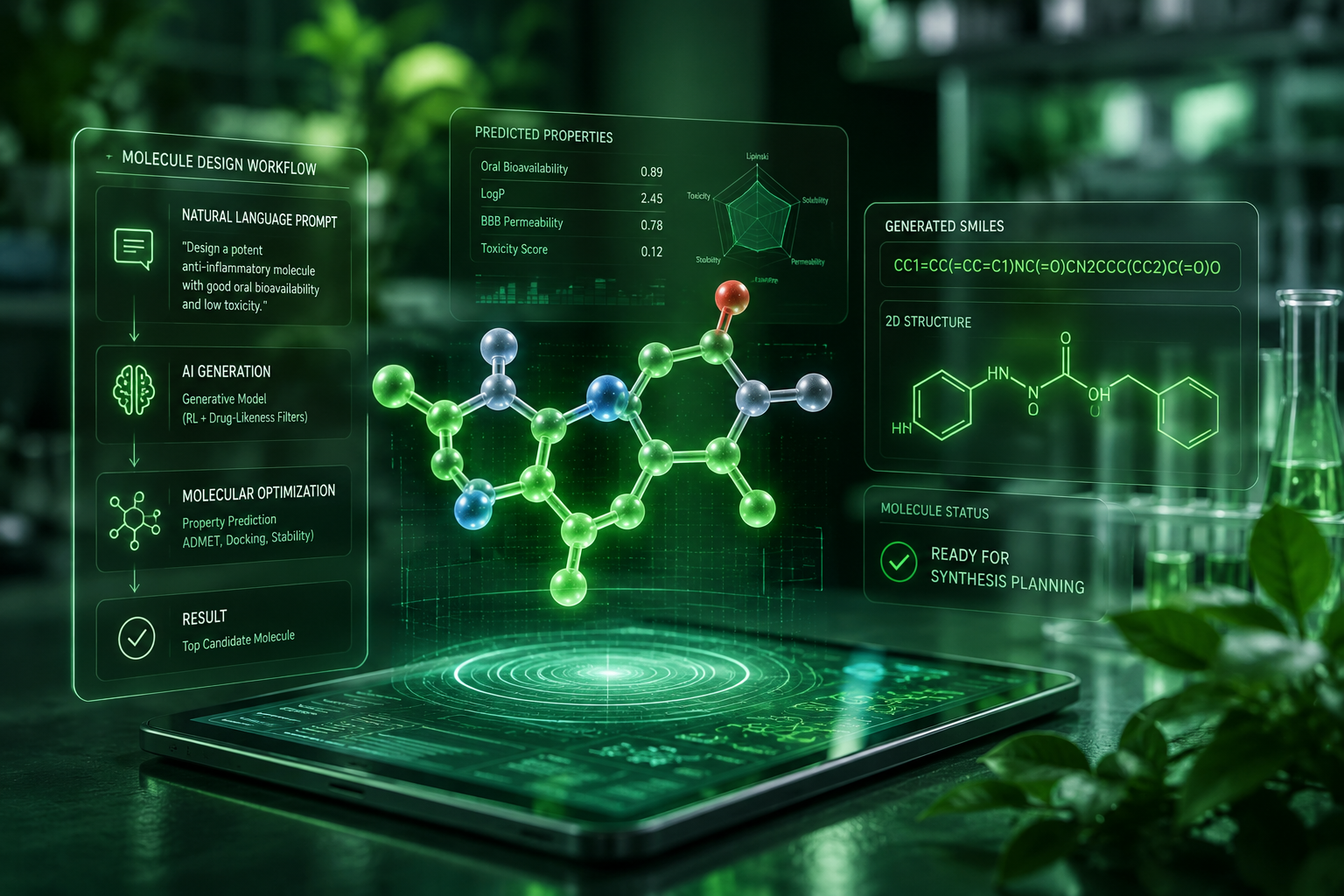
Generative AI in Molecular Biology: Designing Entirely New Flavor Molecules from Scratch
How Machine Learning Is Exploring Billions of Chemical Possibilities to Discover Safe, High-Intensity Sweeteners and Next-Generation Flavor Enhancers
Artificial intelligence is transforming scientific discovery at an unprecedented pace. While much public attention focuses on AI-generated text, images, and software code, one of the most revolutionary applications is taking place far from social media or chatbots—in molecular biology and computational chemistry.
Instead of creating digital artwork, today’s most advanced AI models are helping scientists design entirely new molecules that have never existed in nature. These systems can analyze billions of possible chemical structures, predict how they might interact with human taste receptors, estimate their stability, and prioritize the most promising candidates for laboratory testing.
For the food industry, this represents a remarkable opportunity. Researchers are searching for safer sugar alternatives, cleaner flavor enhancers, sustainable food ingredients, and novel compounds capable of delivering intense sweetness or savory taste while using only tiny quantities. Traditional discovery methods often require years of experimentation and enormous financial investment. Generative AI dramatically accelerates this process by narrowing millions—or even billions—of theoretical possibilities to a manageable shortlist of promising candidates.
Importantly, AI does not replace laboratory science. Every computer-generated molecule must still be synthesized, evaluated for safety, tested for stability, and assessed through rigorous regulatory procedures before it can be considered for commercial use. Nevertheless, artificial intelligence is fundamentally changing how scientists explore the vast chemical universe.
Why Discovering New Flavor Molecules Is So Difficult
Nature contains an extraordinary diversity of chemical compounds.
Plants, fungi, microorganisms, and animals collectively produce millions of molecules capable of influencing aroma, taste, and texture.
Yet only a relatively small number have been studied extensively for food applications.
Traditional discovery involves:
- Extracting natural compounds
- Laboratory analysis
- Chemical synthesis
- Safety assessment
- Sensory evaluation
- Regulatory approval
This process may require many years before a single ingredient reaches consumers.
The Immense Size of Chemical Space
Scientists often refer to chemical space—the enormous collection of molecules that could theoretically exist.
The number of chemically feasible small molecules is estimated to be vastly larger than scientists could ever synthesize or test experimentally.
Exploring this immense space manually is impossible.
Artificial intelligence provides a practical method for searching it efficiently.
What Is Generative AI?
Generative AI refers to machine learning systems capable of creating entirely new outputs rather than simply classifying existing information.
In molecular biology, these models generate:
- Novel molecular structures
- Chemical modifications
- Candidate ingredients
- Optimized molecular properties
- Synthetic pathways
Rather than copying known compounds, AI proposes previously unexplored possibilities that satisfy specific design goals.
Training AI to Understand Chemistry
Modern AI systems learn from enormous scientific datasets containing:
- Molecular structures
- Chemical reactions
- Biological activity
- Toxicology data
- Protein interactions
- Flavor databases
- Receptor binding studies
By identifying complex relationships within these datasets, AI learns the underlying “language” of chemistry.
Human Taste Begins with Molecular Receptors
Taste perception depends on specialized receptors located primarily on taste receptor cells in the tongue and throughout parts of the oral cavity.
Different receptors respond to different categories of molecules associated with sensations such as:
- Sweet
- Bitter
- Sour
- Salty
- Umami
Scientists also continue investigating molecular mechanisms involved in additional sensory characteristics including fat perception and mouthfeel.
Understanding receptor interactions allows AI models to predict which molecular features may influence taste.
Predicting Receptor Binding
One of AI’s greatest strengths is predicting molecular interactions.
Researchers use deep learning models to estimate whether a newly designed molecule is likely to bind to a specific taste receptor.
This enables scientists to eliminate unlikely candidates before laboratory synthesis begins.
As a result, experimental resources can be concentrated on the most promising compounds.
Searching Billions of Possibilities
Instead of evaluating molecules individually, AI systems rapidly explore enormous numbers of possible structures.
The models can optimize multiple characteristics simultaneously, including:
- Predicted sweetness
- Molecular stability
- Water solubility
- Manufacturing feasibility
- Environmental sustainability
- Safety-related properties
This computational screening dramatically shortens the early discovery process.
Designing High-Intensity Sweeteners
Reducing sugar consumption has become a global public health priority.
Researchers are searching for molecules that provide intense sweetness while requiring only extremely small quantities.
Potential advantages include:
- Lower calorie intake
- Reduced sugar consumption
- Improved product stability
- Smaller ingredient volumes
- Enhanced formulation flexibility
Generative AI accelerates the identification of candidates worthy of experimental evaluation.
Developing Novel Flavor Enhancers
AI is also helping scientists investigate compounds that enhance existing flavors.
Rather than adding stronger ingredients, certain molecules may increase the perception of:
- Sweetness
- Umami
- Aroma intensity
- Mouthfeel
- Flavor persistence
Such ingredients could help manufacturers reduce sodium or sugar without substantially compromising sensory quality.
Safety Comes First
Designing a promising molecule is only the beginning.
Before any ingredient reaches consumers, researchers must carefully evaluate:
- Toxicity
- Metabolism
- Stability
- Allergenic potential
- Environmental impact
- Manufacturing consistency
Regulatory approval requires extensive scientific evidence.
Artificial intelligence assists discovery but cannot replace comprehensive safety assessment.
AI and Molecular Simulation
Advanced computational models increasingly combine generative AI with molecular simulations.
These tools estimate how candidate molecules behave under different conditions, including:
- Temperature
- Acidity
- Food processing
- Storage
- Digestion
Simulation helps identify molecules likely to remain stable throughout manufacturing and consumption.
Sustainable Ingredient Discovery
Climate change and resource limitations encourage the development of sustainable food ingredients.
AI supports this objective by identifying molecules that may:
- Reduce agricultural demand
- Minimize waste
- Improve production efficiency
- Utilize renewable feedstocks
- Lower environmental impact
These approaches align with broader sustainability goals across the food industry.
Precision Fermentation and AI
Many next-generation ingredients may not require traditional chemical manufacturing.
Researchers increasingly combine AI-designed molecules with precision fermentation.
Engineered microorganisms can potentially produce selected compounds under carefully controlled conditions, improving scalability and reducing environmental impact.
Personalized Flavor Design
Future AI systems may account for individual biological differences.
Because genetics influence taste receptor sensitivity, personalized flavor formulations could eventually consider:
- Age
- Dietary preferences
- Health conditions
- Cultural food habits
- Individual sensory responses
Although this field remains in its early stages, it represents an exciting area of ongoing research.
Beyond Food Applications
The same technologies used for flavor discovery also support innovation in:
- Pharmaceuticals
- Fragrances
- Agriculture
- Cosmetics
- Biomaterials
- Industrial biotechnology
The ability to design molecules computationally has broad scientific significance beyond food science alone.
Challenges Facing AI-Designed Molecules
Despite remarkable progress, important obstacles remain.
Researchers continue working to improve:
- Prediction accuracy
- Experimental validation
- Biological complexity modeling
- Regulatory acceptance
- Manufacturing scalability
- Long-term safety assessment
Computational predictions remain hypotheses until confirmed experimentally.
Ethical and Regulatory Considerations
As AI-generated molecules become more common, regulators and researchers must address questions including:
- How should AI-assisted discoveries be evaluated?
- Who owns AI-designed molecular structures?
- How can transparency be maintained?
- What evidence should support safety approval?
- How should consumers be informed?
Responsible innovation requires scientific rigor, transparency, and strong regulatory oversight.
The Future of AI-Driven Molecular Discovery
Looking ahead, researchers expect AI to become an increasingly valuable partner in molecular science.
Future systems may:
- Explore larger regions of chemical space.
- Predict biological activity with greater accuracy.
- Integrate laboratory robotics with AI-guided experimentation.
- Accelerate sustainable ingredient development.
- Improve personalized nutrition.
- Support rapid responses to emerging food and health challenges.
Rather than replacing scientists, AI will continue expanding their ability to explore complex biological questions.
Best Practices for AI-Assisted Flavor Innovation
Organizations developing AI-designed flavor compounds should:
- Combine computational predictions with rigorous laboratory validation.
- Prioritize consumer safety throughout development.
- Build diverse, high-quality molecular datasets.
- Collaborate across chemistry, biology, toxicology, and data science.
- Validate AI predictions using experimental evidence.
- Maintain transparent regulatory documentation.
- Design ingredients with sustainability in mind.
- Continuously refine models using new scientific data.
The most successful programs integrate artificial intelligence with expert scientific judgment at every stage.
Conclusion
Generative AI is redefining molecular biology by enabling scientists to explore vast regions of chemical space that would be impossible to investigate through traditional experimentation alone. By analyzing enormous molecular datasets, predicting receptor interactions, and proposing entirely new chemical structures, machine learning is dramatically accelerating the discovery of potential high-intensity sweeteners, flavor enhancers, and sustainable food ingredients. While every AI-designed molecule must still undergo rigorous laboratory testing, toxicological evaluation, and regulatory review before reaching consumers, these computational tools are already transforming the earliest stages of scientific innovation.
As advances in artificial intelligence, molecular modeling, precision fermentation, and computational chemistry continue to converge, the future of flavor development will become faster, more precise, and increasingly sustainable. Instead of relying solely on trial-and-error experimentation, researchers are entering an era in which intelligent algorithms help uncover safe, effective, and previously unimaginable molecular solutions—opening new possibilities for healthier foods, improved nutrition, and the next generation of sensory experiences.